Indiana
All the Bright PlacesIndiana is more than the setting for the characters’ travels: it is a landscape they learn to read by going out into it, finding unexpected destinations and returning to places changed by what happened there. The state’s unassuming landmarks become measures of companionship, memory, and grief, while the wandering project gives its scattered roads and sites a shared shape.
A landscape of unexpected landmarks
At Hoosier Hill, the highest point in Indiana, the arrival is deliberately anticlimactic. A sign identifies the elevation as 1,257 feet, but the marker itself is only a wooden stake among stones in a brown clearing, with a bench and picnic table nearby. The modest scene falls short of grandeur, making the journey’s value less about reaching an impressive summit than about discovering what the place actually is.
Bookmobile Park offers a different kind of surprise. Just outside Bartlett, it lies along a country road bordered by cornfields. On the flat, sparsely treed land, seven bookmobile trailers seem to rise like skyscrapers; they are lined up beside the field, each advertising a different category of books. The unusual site also stirs Violet Markey’s memories of book hunts with her parents and Eleanor Markey in California, connecting an Indiana excursion to a family ritual from before her sister’s death.
Places made intimate by travel
At Purina Tower, a climb up the steel ladder brings Theodore Finch and Violet above the town’s lights and dark patches of trees. From their position beside a Christmas tree that remains there year-round, the lights below seem to merge with the stars overhead. Violet’s sense that the view is lovely, and Finch’s suggestion that the town feels as though it belongs to them, turn a local landmark into a brief shared refuge. The place matters not for its height alone, but for the intimacy the two create there.
The Blue Hole near Prairieton carries a more unsettled reputation. It is a three-acre lake on private property, ringed by trees, and Finch introduces it through local legends: that it is bottomless, that a force pulls swimmers toward an underground river, and that people once disappeared there. He also recounts a 1969 expedition by two sheriff’s deputies, who found a whirlpool but never located the bottom. When Finch and Violet visit on the first warm day, the secluded blue pool feels to Finch like a world apart. Its beauty and its stories of danger coexist, giving the setting a double character as refuge and threat.
A map of memory and loss
Indiana’s sites acquire another weight after Finch disappears. On April 5, the anniversary of Eleanor Markey’s death, Violet and her parents visit A Street Bridge to lay flowers at the place where Eleanor was killed. In the dried riverbed, Violet recognizes a license plate embedded in the ground; a small garden has been planted around it. Finch made that garden. His unannounced act links the two sisters’ histories and gives the memorial a trace of care, even as Violet wonders when he found the plate and when he returned.
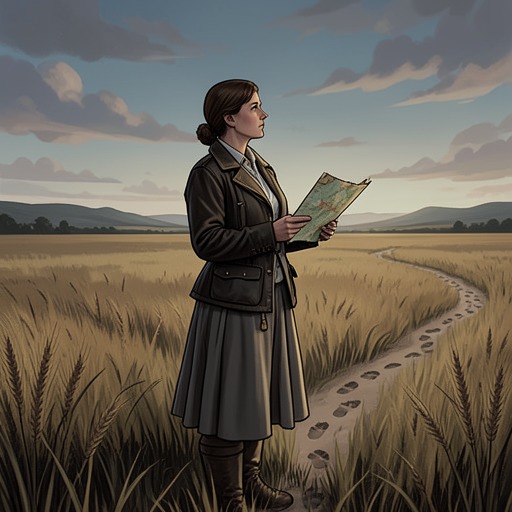
Violet later continues the wandering project without Finch, buying a replacement map because he has the original. At Devils Hollow, near Milltown, she finds trees covered with hundreds of shoes. She leaves a green pair of Chuck Taylors and Eleanor’s yellow Keds on the tree she understands to be the original, its darkened trunk marked by repeated lightning strikes. The gesture brings her sister into the journey rather than treating the remaining destinations as a route she must complete alone.
Another stop is Taylor Prayer Chapel, a small white chapel with a steeple, a wooden cross, and a sign near a lake. Violet reaches it after following the road back and noticing a turn she had missed. She sits there wondering whether Finch came on the day he died or the day before, questions the place cannot answer. The chapel becomes a point in her search for the meaning of his last movements, not a source of certainty.
Returning to the Blue Hole
On June 20, Violet returns to the Blue Hole. She stands on its grassy shore, enters the water, and searches beneath the surface even though she knows she will not find Finch. The return changes the lake from the secluded setting of an earlier shared visit into a place of solitary remembrance. Her thought that Finch may be wandering in another world leaves the project’s geography open-ended: the map can guide her to Indiana’s places, but it cannot resolve his absence. What it can do is let her keep moving through a landscape that now holds both their experiences.